
Disclaimer
- The reviewed IEM is sponsored by Plunge Audio, I grant my utmost gratitude to Simon Fisk for making this review possible. Nevertheless, all opinions remain original ideas, there was zero influence from any 3rd party or external opinions throughout the review.
- No EQ or filter presets were used during the entire sound evaluation.
- Sound evaluation are kept neutral and does not include 3rd party accessories (ie; eartips, cable, reversible mods)
Pros
- Superior ergonomics thanks to the custom-like universal fit
- Excellent, robust build quality including the stock cable.
- Premium inclusions (eg: eartips and custom 3D-printed hard case).
- Great mid-bass performance, rapid, tight and punchy bass slams.
- Exceptional midrange clarity and forwardness while still sounding natural.
- Highly resolving and vivid treble.
Cons
- Emphasised upper-mids may come across being too shouty especially with neutral/sterile sounding sources.
- Subtle, lean sub-bass may disappoint those who prefer a much more aggressive/vigorous rumble.
- Mid-bass is a tad dry
- Peaky treble may deter those who are sensitive to sharp treble.
Introduction
In the world of professional audio, there is a distinct difference between gear that sounds good on a desk and gear that survives a three-hour set under stage lights. As an audio reviewer, I see hundreds of IEMs that promise “studio-grade” performance, but only a few managed to deliver their promise. However, in my review this time is the Plunge Audio Unity Dynamic. For those who haven’t known yet, Plunge Audio is a Canadian brand who has been around for 15 years making primarily custom in-ears. But that changed in 2018 when Plunge Audio introduced the Unity Stage, a flagship with 4 BA units per side with custom-like universal fit. Each IEMs are designed and handcrafted by a team of working musicians, Simon Fisk and Justin Kudding. With a unique tubeless design and a proprietary venting system, the Unity Dynamic aims to bring the scale of open-back headphones into a rugged, universal shell. Today, we’re finding out if Unity Dynamic truly delivers the “custom-fit” experience they promise for the working pro.
Unboxing Experience
The unboxing experience of the Plunge Audio Unity Dynamic is straightforward and what you’d expect from an IEM made for professionals, no bells and whistles, just straight utilitarian and fits the purpose of this product. That said, Plunge Audio does not provide us with barebones, basic accessories. Inside the 3D printed travel case which by the way, is impressively high quality. Users will find a full set of Tangzu Tang Sancai Balanced eartips as well as a full set of Divinus Velvet Wide Bore eartips as stock, which can be considered as a luxury in pro audio equipment when compared to its competitors.


There is also a cleaning brush and last but not least, a small carrying pouch where the Unity Dynamic is stored and already pre-attached to the cable. Other than that, there is also a greeting card included, alongside a handy carabiner with “Plunge Audio” branding on the surface to hook the case on your belt loop or simply attach it to your bag during travelling.
Specifications
- Driver: Single 9.2mm LSR (Liquid Silicone Rubber) Dynamic Driver
- Impedance: 32 Ohms
- Sensitivity: 96dB/SPL @ 1mW
- Frequency Response: 10Hz-20kHz
- Cable: 1.3m SPC (silver-plated copper) with 80 core OFC (oxygen-free copper) shielding to 2-pin (0.78mm)
- Nozzle diameter: 5mm
- Weight: NA
Build and Comfort
One of the key features that makes Plunge Audio in-ears stand out is the overall build and design, the entire chassis of the IEM is made out of high-quality resin which feels extremely solid, very lightweight and the textured surface provides a unique sensory experience. The faceplate of the IEM features a layer of cerakote coating which is a type of polymer-ceramic coating that is highly durable to withstand abrasion, impact, corrosion, etc and it is commonly used in firearms industry. This is perfect especially considering that these IEMs would need to be able to provide the durability and longevity for performing artists or professionals.


At the heart of this IEM is the 9.2mm dynamic driver with a LSR (Liquid Silicone Rubber) which Simon had been recently obsessed with dynamic drivers based on our conversation over email, I assume there will be more IEMs would be released in the near future featuring DDs such as hybrids and so on. Its custom-like fitting which Simon perfected over many years worked sublimely and fits my ear snug, like a glove and no matter what kind of macromovement such as headbanging, rapidly shaking my head left and right yet still the Unity Dynamic didn’t budge even the slightest. In terms of isolation, the Unity Dynamic is said to be able to achieve up to 18dB or maybe slightly more depending on the seal, there’s a large air pressure vent located just below the connector socket to prevent driver flex as well as functioning as a part of tuning.
Cable
Plunge Audio Unity Dynamic comes with a 1.3 meter long cable that features a silver-plated copper (SPC) and 80 cores of oxygen-free copper (OFC) shielding to protect the cable from various elements such as moisture, humidity and interference. On the outer layer is a thick PVC material which feels durable but still flexible to be able to wrap neatly for storage. At the moment, Plunge Audio ships all of their IEMs with this cable which only comes in 3.5mm single-ended option, which is understandable due to cost, convenience.


Moreover, the cable also features 2-pin recessed connectors design in order to prevent breakage on those tiny 0.78mm pins especially since this is an IEM made for on-stage usage. There’s a large left and right indicator, as well as a red and blue coloured dot on each side of the connectors and along the cable, users will find Plunge Audio logo on the Y-splitter and branding on the plug case which all of these are made using lightweight metal with a smooth matte finish. Overall, although the weight is slightly on the heavier side, the cable feels excellent, highly durable, ergonomic and most importantly looks amazing.
Test Equipment
- Local Hi-Res files > Astell&Kern SE100 M.Chat (Linear Phase Fast Roll-off Filter)
- Tidal (Master) + Local Hi-Res files via UAPP > Sony Xperia 1 V + DSEE Ultimate (ON), Dolby Atmos (OFF)
- Tidal (Master) + Local Hi-Res files via UAPP > Sony Xperia 1 V > Kiwi Ears Allegro Pro
Power Requirements
For reference, my comfortable listening volume is around 56.5 decibels which is between whispering and the sound of a normal conversation. Therefore, the Unity Dynamic which is rated at 32 Ohms and a sensitivity of 96dB/SPL and as the stats suggest, this IEM does require a decent amount of power to push it to its highest potential. Although it is not as demanding as anything such as planar magnetic drivers, an additional amplification does allow the dynamic driver to be slightly more responsive especially in delivering the lower frequencies. Plugging it straight into my Sony Xperia 1 V, it required me to crank up my volume rocker up to 10-12/30 to achieve my comfortable listening volume. Meanwhile, on a more powerful device such as the A&K SE100, I had to turn the wheel up to 50-52/150 to achieve my desired loudness for both casual and critical listening.
Sound Evaluation
The Plunge Audio Unity Dynamic has undergone burn-in phase for at least 48 hours prior to sound evaluation. Throughout the analysis, I paired up the Unity Dynamic with a neutral source, the A&K SE100 on Linear Phase Fast Roll-off Filter chosen given that it’s the most natural sounding filter compared to default. Divinus Velvet Wide Bore ear tips which are included inside and 3.5mm single-ended are set as default throughout the sound evaluation. Bonus test tracks used can be found down at the end of this review.

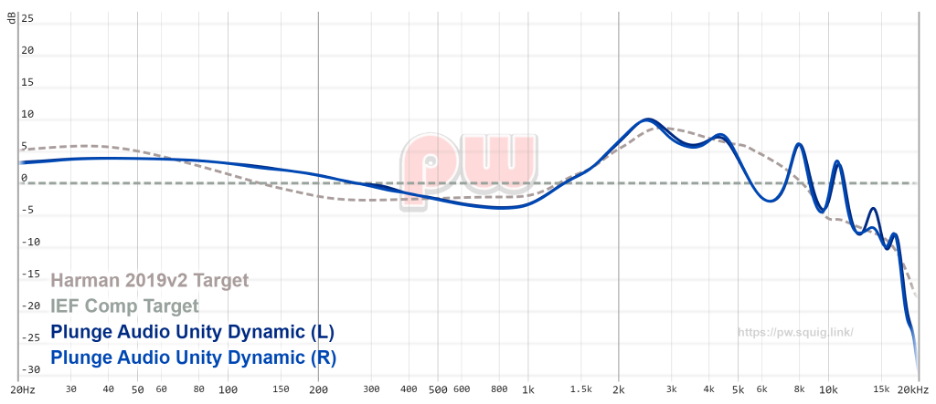
In short, the Plunge Audio Unity Dynamic is a bright, V-shape sounding pair of IEMs with a clear emphasis on the upper-mids and higher frequencies. As I’d expect, the bass on this IEM is quite lean but still capable of delivering meaty and tight, hard bass punches. Although the sub-bass is slightly less prominent, it sounded rather polite and flat without much depth. The midrange received some colouration due to the excess elevation from the lower frequencies, therefore vocals and stringed instruments sounded a tad warmer and thicker. That being said, the midrange clarity remained impressively unaffected and crystal clear. Moving upwards, the Unity Dynamic has a prominent upper-mid presence, while it does help instruments and percussions this does also resulting in a strong vocal forwardness, which may come across being too shouty for those who have lower tolerance towards emphasised upper-mid. Treble on this pair is on the brighter side with excellent clarity, detail retrieval and vividness, but it does also come with a cost being a bit sharp which can be seen through the peaky graphs starting from the dip at 4.5kHz which stretches all the way past 10kHz.
Low Frequency (Bass)
Sub-bass reaches deep into the lowest frequencies with a textured rumble, the rumbling effect does feel quite subtle rather than aggressive and vigorous when tested with tracks such as Hollow (16 bit Remix) – Björk. Mid-bass is slightly north to neutral and punches delivered by the 9.2mm DD hits hard, precise and fast, while still able to retain its natural characteristics whereby the reverberations were naturally dispersed for quite a short period of time. I could not find any muddiness in the bass, everything sounded clean, airy with excellent clarity. Nevertheless, the bass on the Unity Dynamic does sound a tad dry but I still very much enjoy the IEM especially when played with Rock genres such as from Porcupine Tree, Opeth which really highlights the snares, toms being hit. It felt impactful, realistic and really engaging.
Middle Frequency (Mid)
Midranges are terrific which makes it one of the highlights of this IEM, it has amazing clarity, forwardness and resolving. Tonal balance is slightly above neutral which gives vocals and instruments an added layer of body and naturalness rather than colouration which results in a much richer, thicker sound. Upper-mid is emphasized, detailed and really highlights the natural qualities and depth in the midrange. Therefore, qualities from stringed instruments, especially male and female vocals are the focal point compared to other elements. However, I do feel those with higher sensitivity towards emphasized ear gain will find this IEM to be a bit overwhelming and fatiguing after listening over a period of time.
High Frequency (Treble)
Treble is also one of the dominant frequencies in this IEM to my perception, these are a pair of vivid and highly resolving IEM with very good clarity. Upper-treble past 10kHz have a good amount of extension, hence tails from crash cymbals and hi-hats are crisp and slightly accentuated due to this reason. There is a good amount of airiness which gives the Unity Dynamic a sense of spaciousness and room for other elements to breathe. Personally, though I don’t find the Unity Dynamic to be sibilant at all, the peaky treble especially past 5kHz and above can be slightly sharp and fatiguing especially at higher volumes. That said, in professional use cases such as monitoring these do perform excellently in exposing imperfections, technical flaws in a mix.
Technicality
Soundstaging on the Unity Dynamic is average which extends a tad beyond the head even while using wide bore eartips, with the soundstage depth extending greater than the width of the soundstaging. Additionally, thanks to the well-designed vent holes and treble extension the soundstaging still sounds natural and articulated. Imaging on the other hand is sharp and accurate, even on busier tracks the Unity Dynamic have no issues rendering accurate movements of an element.
Detail retrieval on the other hand is excellent, capable of rendering high and low-level details or people often call it as macro/microdetails. Resolution is also quite impressive although there is a slight haziness/blurriness albeit not by a huge margin. For instance, in the track Nod-Krai – HOYO-MiX, AURORA the subtle reverberations and textures coming from the strings of a double bass being plucked were easily rendered. Meanwhile, in tracks such as Fall in Love Alone – Stacey Ryan, the IEM appears to struggle slightly and sluggish to render the deep, textured sub-bass rumbles. Layering was average at best, as the Unity Dynamic could get slightly cramped with multiple playing at once while separation on the other hand is rated above average. Every element is well-placed, separated from each other and easily distinguished.
Lastly for the dynamic range test for the Plunge Audio Unity Dynamic is rated at above average. Utilizing the Ultimate Headphone Test – ABYSS Headphone dynamic range test as a reference. In short, a sample sound of a drum and a bell are played simultaneously as much as 7 counts, but only the sound of the bells will become quieter. Hence, from a scale of 7 counts, Unity Dynamic was able to produce an audible 6 out of 7 counts.
Comparison(s)
Tipsy M1
Apart from the price, the most obvious difference between these two IEMs are the sound signature, the M1 appears to be a much warmer, laid-back sounding IEM to the Unity Dynamic. Bass punches felt heftier, slightly slower transients and thicker but at the same time it skews towards boomy on the M1. Both IEMs excel in delivering articulate, high quality midrange with above average clarity, to add as well timbre on both IEMs sounded natural albeit in terms of tonality, M1 sounded slightly warmer and richer especially in terms of vocal and stringed instruments. However, the M1 sounded a lot more tolerable but a tad less forward presence in the upper-mid compared to the Unity Dynamic, nevertheless it is a much safer option especially for those with lower tolerance to emphasised ear gain frequencies. In the treble, we have two polarizing sides with the M1 being a much laid-back IEM, meanwhile the Unity Dynamic was much brighter, vivid and sparkly. That said both offer very good detail retrieval, airiness, separation and wide dynamic range. Albeit, the M1 fell slightly short in terms of resolution and layering. But, I do personally feel that the M1 has a much larger soundstaging.
Purchasing Links and Where to Get?
Plunge Audio Official (not affiliated) : https://plungeaudio.com/products/unity-dynamic-iems

Conclusion
To conclude, the Plunge Audio Unity Dynamic is an example of a purpose-driven design. It doesn’t try to be a “do-it-all” pair of IEMs compared to other in-ears. Instead, it delivers what the Unity Dynamic is meant for as a tool for the working professional. Every element chosen feels like it is made for a purpose, from the material selection, the cerakote coating on the faceplate, to the design of the IEM itself and most importantly is the sound tuning.
Sonically, it offers a rather bright V-shaped signature which might not appeal to the average consumer who would want a safer or lush option. The upper-mid forwardness and crisp treble extension make it an ideal companion for monitoring vocals and live instrumentation where clarity and transparency is most prioritized. These characteristics are precisely what makes this IEM excel at exposing the nuances and imperfections in a mix.
Hence, if you are a musician, engineer, or an audiophile who values raw detail and a flawless fit over a warm, coloured sound profile the Unity Dynamic is an easy recommendation. That wraps up my review for the Plunge Audio Unity Dynamic, I really appreciate it if you’ve read this far however until next time!
Additional Test Tracks
Can You Stand The Rain – Boyz II Men 44.1kHz
Money For Nothing (Explicit) – Dire Straits 44.1kHz
A Poem Titled You – TAEYEON 44.1kHz
Anesthetize (Live) – Porcupine Tree DSD256
Vermilion – Slipknot 44.1kHz
Kanade – SUKIMASWITCH 44.1kHz
La vaguelette (Original Game Soundtrack) – HOYO-MiX 44.1kHz
Rhythm – Jamey Haddad, Lenny White; Mark Sherman 44.1kHz
Kimigatame (When Suara Meets DSD 11.2Mhz) – Suara DSD11.2MHz
Just Coolin’ – Art Blakey 192kHz
Automatic – Hikaru Utada 44.1kHz
In My Room – Hikaru Utada 44.1kHz
Colors (Live in Studio) – Black Pumas 192kHz
Timbres – Yosi Horikawa 44.1kHz Misguided Ghosts – Paramore 44.1kHz