
Disclaimer
- The reviewed IEM is sponsored by Tipsy Audio, I grant my utmost gratitude to Mason from Tipsy Audio for making this review possible. Nevertheless, all opinions remain original ideas, there was zero influence from any 3rd party or external opinions throughout the review.
- No EQ or filter presets were used during the entire sound evaluation.
- Sound evaluation are kept neutral and does not include 3rd party accessories (ie; eartips, cable, reversible mods)
Pros |
Cons |
|
|
Introduction
The term “monitor” or “studio” has been the name of the game, the objective we often hear in the IEM space, often as a byword for a flat, boring, or overly analytical sound. Tipsy Audio with their most recent M-series lineup and the slogan “Signature Sound, Absolute Precision”, is a lineup aimed squarely at performers, producers, and audio pros in mind. The last time I heard anything from Tipsy was back in 2022 with TTromso and ever since then their newer models never got into my radar. Nevertheless, the brand is re-emerging with the M1, M3, and the upcoming M5 which was recently announced. The M1, which we have today, is the most affordable entry point to this new pro-focused vision which retails at $99. Therefore, let’s see if the M1 can actually deliver “studio accuracy” promise without the “musician’s” price tag.
Unboxing Experience
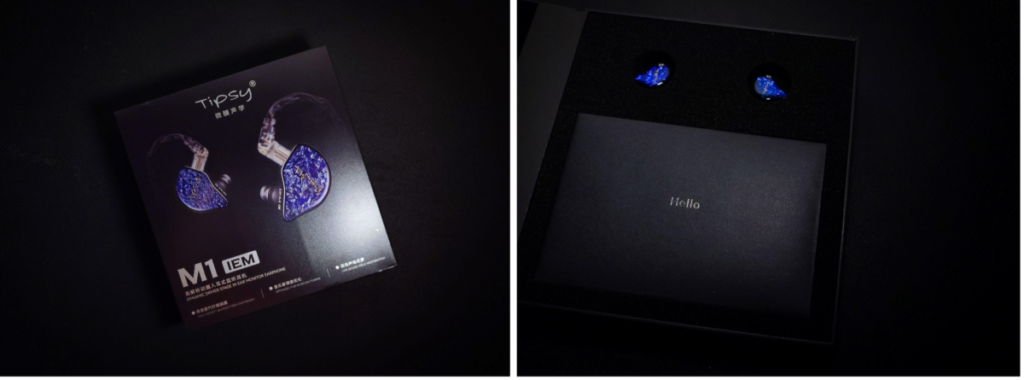
Tipsy has done a really great job with the presentation for the M1, from the graphic designs on the outer layer of the packaging telling all the details regarding the IEM, to the presentation of the product itself in the inside. It felt premium and overall a very well presented product while still keeping the straightforward appeal for the professional audience. Unboxing the inside reveals the IEM itself resting in a foam cutout, an envelope containing the manual, warranty card and an introduction to Masan Lee, the man behind Tipsy Audio who started the company back in 2016.
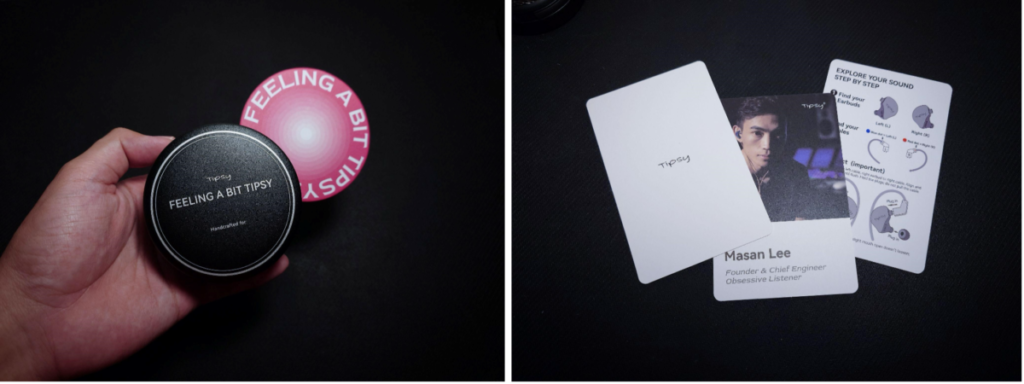
There’s also a round IEM case made with hard plastic and last but not least a disposable coaster made with cardboard which is printed with some graphics alongside Tipsy’s catchphrase “Feeling a bit Tipsy. Other accessories such as the cable and eartips are located inside the hard case, there are two sets of eartips included with the M1, three pairs of short stem silicone eartips and a slow rebounding memory foam eartip.
Specifications
- Driver: 10mm custom-made bamboo fibre diaphragm, with double cavity design dynamic driver
- Impedance: 24 Ohms
- Sensitivity: 106dB/mW
- Frequency Response: 20Hz-20kHz
- Cable: 1.2 meter, 4 braid, high purity alloy copper cable with QDC 2-pin to 3.5mm (6.3mm adapter included)
- Nozzle diameter: 5mm
- Weight: NA
Build and Comfort
At the heart of this IEM is a custom-made 10m dynamic driver with a diaphragm that Tipsy claimed to be the world’s first using this technology in an IEM, which is the bamboo fibre diaphragm. To add more from Tipsy’s website, due to the fibrous nature of bamboo, the structure of the diaphragm surpasses metal and PET diaphragms in many aspects such as rigidity, damping and resonance in order to produce faithful sound reproduction. However, this is all pretty much theoretical information as we’ll get to the sound evaluation soon.
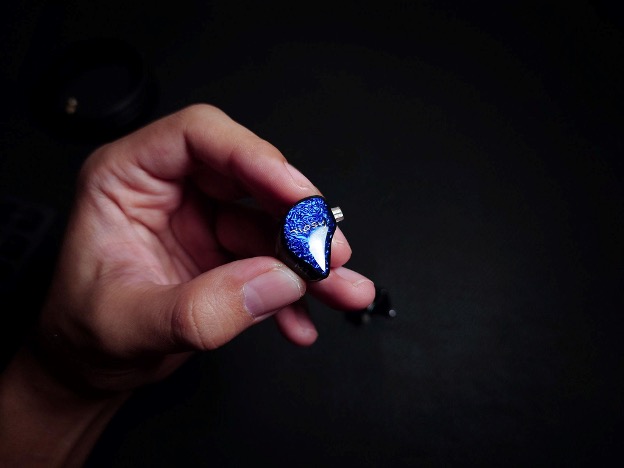
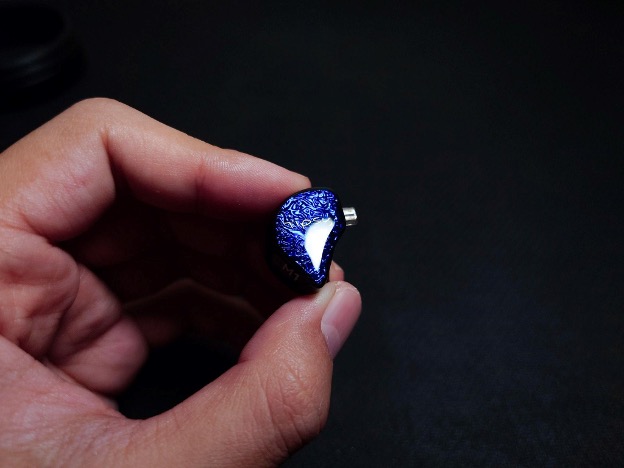
In terms of design, the Tipsy M1 has a small silhouette and at the same time being very lightweight, combined with the nozzle size which I have measured to be at 5mm, the M1 was very comfortable to wear even for those with smaller ears. According to the details found on both website and the packaging of the IEM, the shell is made using high precision 3D printing and cured with clear resin that results in an IEM with a shiny, glossy finish that feels very smooth to the touch, albeit it does become fingerprint magnets. M1 is available in three different designs to choose from and all of them are handmade by the artist at Tipsy which are inspired from artworks by famous artists. Red represents Mattise’s The Red Studio, Green as in Van Gogh’s Green Wheat Field at Auvers and Blue as in Van Gogh’s Starry Night. There is a vent pressure hole on each side to relieve some negative pressure inside the IEM, I could not hear any crinkling noise coming from the dynamic driver which is a good sign that there is no driver flex.
Cable
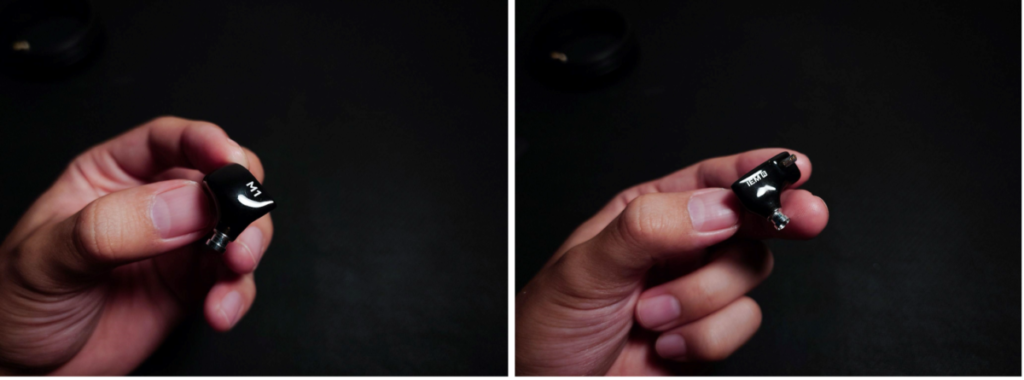
Tipsy M1 came with a great looking cable, it reminds me a lot of the cable that comes with the Acoustune RS series albeit the Acoustune is slightly thinner and stiffer compared to the M1’s stock cable due to the kevlar shielding. The cable is a simple, twist braided cable that is soft and very manageable. I find the cable to be resistant from being tangled. Measured at 1.2 meter which is standard for most IEMs, the stock cable features a 4 core braiding, made with high purity alloy copper cable as per advertised on the packaging of the M1, the PVC shielding feels smooth and soft. I could not hear any microphonics or static noises coming into the IEM when the cable was touching or rubbing against various textures including my clothes while wearing it.
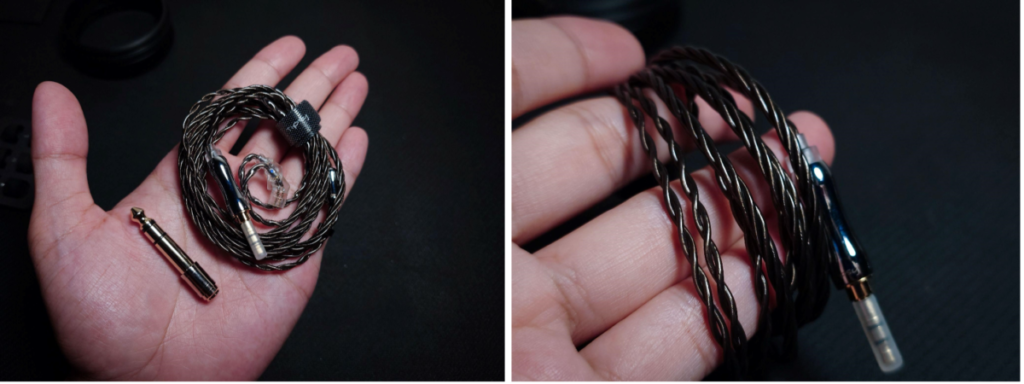
The accessories such as the Y-splitter and 3.5mm termination casing are made using metal finished with an engraved “Tipsy” branding which feels substantially heavy and well-made but overall the cable still feels very lightweight. Meanwhile, the QDC connectors are made using plastic with textured finish and also have a “Tipsy” branding on the sides. Being an IEM made for professional musicians in mind, Tipsy included a 6.3mm adapter for the ease to plug the M1 on personal in-ear monitor amplifiers, etc. Unfortunately, the cable is only available in 3.5mm single-ended as the only option, hence users will need to swap the cable to use the IEM with a balanced plug.
Test Equipment
- Local Hi-Res files > Astell&Kern SE100 M.Chat (Linear Phase Fast Roll-off Filter)
- Tidal (Master) + Local Hi-Res files via UAPP > Sony Xperia 1 V + DSEE Ultimate (ON), Dolby Atmos (OFF)
- Tidal (Master) + Local Hi-Res files via UAPP > Sony Xperia 1 V > Questyle M18i
- Tidal (Master) + Local Hi-Res files via UAPP > Sony Xperia 1 V > Kiwi Ears Allegro Pro
Power Requirements
Rated at 24 Ohms and with a sensitivity of 106 dB/mW, Tipsy M1 is a fairly efficient pair of IEM. Throughout my testing, I have yet to find any problems powering this IEM up to its maximum potential via the various sources available in my setup. From small dongles such as the Kiwi Ears Allegro Mini and my Sony Xperia 1 V all the way to larger, much powerful amplifiers such as the Questyle M18i, Fosi Audio PH-5, etc. However, while on paper it does appear to seem efficient, in real life testing the M1 works best when amplified as I noticed the dynamic driver does sound much more responsive when hooked to an amp. For instance, powering the M1 through my reference DAP, the Astell&Kern SE100 through the 3.5mm output requires me to turn the volume up between 60/150 and below to achieve my comfortable listening volume which is around 56.5 decibels. Meanwhile, on smaller, portable devices such as the Questyle M18i set on low gain also through 3.5mm output requires me to increase the volume up to 18/60 to achieve similar results.
Sound Evaluation
The Tipsy Audio M1 has undergone burn-in phase for at least 48 hours prior to sound evaluation. Throughout the analysis, I paired up the M1 with a neutral source, the A&K SE100 on Linear Phase Fast Roll-off Filter chosen given that it’s the most natural sounding filter compared to default. Stock ear tips and 3.5mm single-ended are set as default throughout the sound evaluation. Bonus test tracks used can be found down at the end of this review.
My sound preference is always reference-flat tuned or with a very slight warmth which you could find in IEMs such as the Vision Ears VE7, Plunge Audio Unity or the InEar Prophile 8. Bonus test tracks used can be found down at the end of this review.
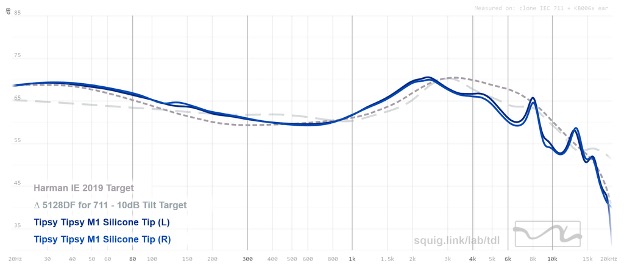
Tipsy Audio M1 is a mild V-shape tuned pair of IEM, which features an elevated bass as much as +10dB maximum in the sub-bass region then gradually extends into the lower-mid. That said, there is a tad roll-off from 20Hz-30Hz by at least 1dB which may not make any noticeable difference. In the mids, we can see that the M1 definitely has an added colouration and slightly more so than the neutral targets, which drops to neutral at just before 500Hz. Moreover, the upper-mid peaks quite early at 2.5kHz compared to both neutral and the Harman target, slightly higher than the bass frequencies as well by 2-3dB which may cause ear fatigue for those sensitive to an emphasized ear gain.
Reaching into the higher frequencies, the Tipsy M1 features a smooth, safe tuning which does also appear to be leaning towards a darker sound signature due to the lack of elevation past 10kHz. Surprisingly, the treble tuning is well-kept under the neutral target although there are peaks and dips within the region. However, it does seem less likely to emit harsh sounds, as the graph looks smooth from end to end. Overall, Tipsy Audio M1 from the graph can be described to have a bassy sound signature with a rich, warmer tonal balance in the lower-mid and a forward upper-mid presentation. Treble on the other hand is in the safe, smooth category with good presence at 4kHz which should provide enough sparkle, although it may sound a bit too dark for some due to the lack of emphasis past 10kHz.
Low Frequency (Bass)
The M1 has a warm and weighty bass, while it may not please bass heads who would prefer a greater amount of quantity in their bass, the M1 is more suited for those who appreciate the quality of the Harman neutral tuning at heart. In the sub-bass, the M1 features delicate and loose bass rumbles effects. Tuning in Hollow (16-bit Remix) – Björk for instance, the M1 was able to deliver the deep, rumbling sub-bass note. However, it does not feel vigorous or aggressive, the rumbles feel soft and airy. In the mid-bass, the M1 is capable of delivering a strong bass punch which resembles a slightly boomy, bouncy and weighty bass slam. Transients were balanced between rapid and slow for a dynamic driver, achieving great balance between making reverberation, rumble effects, etc ended abruptly like a BA driver or too slow between each transient that it’ll cause melding.
Middle Frequency (Mid)
Midrange on the M1 are a tad recessed, warm and rich in tonal balance. The overall presentation is clean, even on busier tracks, vocals and instruments still maintain very good articulation and clarity which is one of the attributes that truly impresses me regarding the IEM. Additionally, the upper-mid is well-controlled despite on paper it might appear slightly shouty, though in real-world testing it is smooth even for those sensitive towards boosted eargain such as myself.
High Frequency (Treble)
Compared to a traditional V-shaped IEM, the treble on M1 is a lot on the softer, smoother side and most will find it quite enjoyable. That said, the treble does not lack any sparkle and brilliance, crashes and hi-hats sounded vivid with an almost lifelike resonance the way the instruments shimmer and transients from one another. I could not hear any sibilance or harshness between 4k-8kHz when testing it with my vocal tracks, nevertheless the M1 does reveal imperfections and harshness when played with poorly recorded tracks as it intended to do for an IEM marketed for professionals. Reaching past 10kHz, the M1 does come quite short therefore it does feel a tad dark, however it’s nowhere near what I would consider it as claustrophobic, everything still sounded pleasant with natural airy ambience.
Technicality
The Tipsy Audio M1 surpassed my expectations in technical aspects. The M1 were able to deliver great detail retrieval qualities capturing high and low-level details, albeit resolution wise is limited to average. For instance, the M1 does have a slight shortcomings rendering subtle vocal qualities such as the low grunt or deep manly voice in male vocals or other elements like subtle sub-bass textures such as deep bass rumbles, etc.
Soundstage on this IEM is best at average yet it sounds open and natural such as the way the resonance is able to dissipate freely and clean. Instead of bouncing inside which will cause unnecessary reverberations and negative pressure build-up which is quite a common problem in single dynamic IEMs hence Tipsy Audio has done a great job in this aspect. Spatial imaging is sharp with good clarity, although not pinpoint accuracy but it is able to portray from which direction an element came from quite easily. Other than that, separation for this IEM I would consider as above average, the way elements are presented clearly and separately from each other. Layering on the other hand is limited to average, while it can handle a decent amount of elements playing at the same time it can be slightly hard to tell the distance of each element from each other.
Lastly for the dynamic range test for the Tipsy Audio M1 is rated at average. Utilizing the Ultimate Headphone Test – ABYSS Headphone dynamic range test as a reference. In short, a sample sound of a drum and a bell are played simultaneously as much as 7 counts, but only the sound of the bells will become quieter. Hence, from a scale of 7 counts, M1 was able to produce an audible 5 out of 7 counts.
Comparison(s)
Plunge Audio Unity Dynamic ($279)
Feature |
Tipsy Audio M1 |
Plunge Audio Unity Dynamic |
Price |
$99 USD |
$279 USD |
Driver Tech |
10mm bamboo fibre diaphragm |
9.2mm LSR single dynamic |
Sound Profile |
V-Shape
|
U-Shape / Mid-centric
|
Soundstage |
Average, fairly airy |
Average, highly immersive |
Disadvantage |
|
|
Advantage |
|
|
Purchasing Links and Where to Get?
Tipsy Audio Official Website
Conclusion
The Tipsy Audio M1 is a refreshing introduction for Tipsy Audio. By utilizing a world-first bamboo fibre diaphragm in the M1, Tipsy has managed to create an IEM that not only sounds but also feels organic and cohesive. It excels in delivering a rich, weighty low-end and clear vocal articulation. I personally am a big fan of the brand new driver implemented in this IEM, therefore I would love to see if Tipsy would stick to this driver in their upcoming models.
The Tipsy Audio M1 is a refreshing introduction for Tipsy Audio. By utilizing a world-first bamboo fibre diaphragm in the M1, Tipsy has managed to create an IEM that not only sounds but also feels organic and cohesive. It excels in delivering a rich, weighty low-end and clear vocal articulation. I personally am a big fan of the brand new driver implemented in this IEM, therefore I would love to see if Tipsy would stick to this driver in their upcoming models.
While the roll-off in the high frequencies might treble heads or even objectivists looking for that surgical micro-detail accuracy. The M1’s smooth, non-fatiguing signature combined with the small form factor makes it an excellent tool for performers and long-term listeners alike.
Additional Test Tracks
Can You Stand The Rain – Boyz II Men 44.1kHz
Money For Nothing (Explicit) – Dire Straits 44.1kHz
A Poem Titled You – TAEYEON 44.1kHz
Anesthetize (Live) – Porcupine Tree DSD256
Vermilion – Slipknot 44.1kHz
Kanade – SUKIMASWITCH 44.1kHz
La vaguelette (Original Game Soundtrack) – HOYO-MiX 44.1kHz
Rhythm – Jamey Haddad, Lenny White; Mark Sherman 44.1kHz
Kimigatame (When Suara Meets DSD 11.2Mhz) – Suara DSD11.2MHz
Just Coolin’ – Art Blakey 192kHz
Automatic – Hikaru Utada 44.1kHz
In My Room – Hikaru Utada 44.1kHz
Colors (Live in Studio) – Black Pumas 192kHz
Timbres – Yosi Horikawa 44.1kHz
Misguided Ghosts – Paramore 44.1kHz